TWS is a Great Training Option for Everyone
Learn more about how we can prepare you to advance your career.
A decade ago, every new residential system ran on R-410A, an A1 refrigerant with no flammability rating. The EPA Section 608 exam had no flammability content to test, and ASHRAE 15’s flammability provisions had no residential application, because there was no flammable refrigerant in the residential fleet for them to apply to. That’s the baseline this shift moved away from.
As of January 1, 2025, new residential and light commercial air conditioning and heat pump systems can no longer be manufactured with a refrigerant above the 700 GWP cap, a Global Warming Potential (GWP) limit set by the EPA. GWP measures how much heat a gas traps in the atmosphere compared to carbon dioxide, so a refrigerant with a GWP of 700 has 700 times the climate impact of the same amount of CO2. R-410A, the refrigerant behind most home and small commercial systems for the last two decades, carries a GWP of 2,088, more than triple that limit.
A curriculum that still trains around R-410A is training on a refrigerant that’s already out of new production. A2L refrigerant training is what fills that gap, and it covers tools, safety procedures, and certification content that didn’t exist in most programs a decade ago. That gap shows up fastest on the job, the first time a graduate has to service equipment their program never covered.
What Set the Change in Motion
The American Innovation and Manufacturing Act (AIM Act) of 2020 gave the EPA authority to phase down high-GWP refrigerants on a fixed schedule. The 700 GWP cap for residential and light commercial air conditioning was the first major milestone under that schedule.
The cap applies only to new manufacturing. Equipment already installed remains legal to service and recharge with R-410A for the rest of its working life.
Get Started on the Path to a New Career
Fill out our form to learn how we can help you change your life.
R-410A and its two replacements compare like this:
| Refrigerant | GWP | Status |
|---|---|---|
| R-410A | 2,088 | Phased out of new manufacturing as of Jan. 1, 2025 |
| R-454B | 466 | Standard in new residential systems |
| R-32 | 675 | Standard in new residential and light commercial systems |
R-454B and R-32 both fall comfortably under the 700 GWP threshold, which is why manufacturers turned to them for new equipment.
What is A2L?
R-454B and R-32 both carry an A2L safety classification, the ASHRAE rating for mildly flammable refrigerants. R-410A carries an A1 rating instead, where a rating of 1 means the refrigerant won’t ignite under any tested condition and a rating of 2L means mildly flammable, difficult to ignite but not incapable of it.
That rating difference, the number after the letter, is the entire reason A2L refrigerant training exists as its own category.
The EPA frames the switch as a worthwhile tradeoff. A small amount of flammability risk buys refrigerants that are far less damaging to the climate and more efficient to run. That tradeoff is exactly what changes the tools and procedures a technician uses on the job.
What Changes for a Technician in the Field
A2L refrigerant training starts with leak detection. Standard detectors built for nonflammable R-410A service aren’t sensitive enough to catch the small flammable concentrations A2L systems can release, a gap ASHRAE 15 addresses through specific charge limit and ventilation requirements. Technicians now calculate clearance from ignition sources on every job instead of relying on general caution.
That charge limit is tied directly to room size. ASHRAE 15 calculates the maximum amount of refrigerant a system can hold so that even a full release stays below the concentration needed to ignite, which means the same equipment can carry a different allowable charge depending on where it’s installed.
A technician working on A2L systems needs:
- A2L-rated leak detectors, sensitive enough to catch small flammable concentrations
- Recovery machines and vacuum pumps carrying A2L or UL certification
- Hoses and fittings built for flammable refrigerant service
Brazing and charging procedures also shift. A2L equipment follows a different sequencing than R-410A service, built around the lower ignition threshold rather than the nonflammable assumptions older training relied on. Charging in particular now involves more deliberate leak checks at each stage, since a mistake that would only cost refrigerant on an R-410A job now carries a flammability risk, too.
What Certification Requires Now
EPA Section 608 still issues the same four certification types it always has:
| Certification Type | Covers |
|---|---|
| Type I | Small appliances |
| Type II | High- and very high-pressure appliances |
| Type III | Low-pressure appliances |
| Universal | All equipment types, including A2L |
Universal certification already covers A2L handling, so nothing new was created for it. What changed is the exam itself, which now tests flammability handling that wasn’t part of the content a decade ago. ASHRAE 15’s charge and ventilation calculations now fall to the technician doing the install.
That calculation isn’t paperwork to skim past. It determines whether a given room, closet, or mechanical space can legally hold the equipment size a job calls for, and getting it wrong can mean an install that has to be redone.
What a Program Needs to Teach to Keep Up With This
A curriculum built for this transition prepares students to pass the exam. It also puts them on the actual equipment they’ll use in the field before they ever touch a customer’s system. That means:
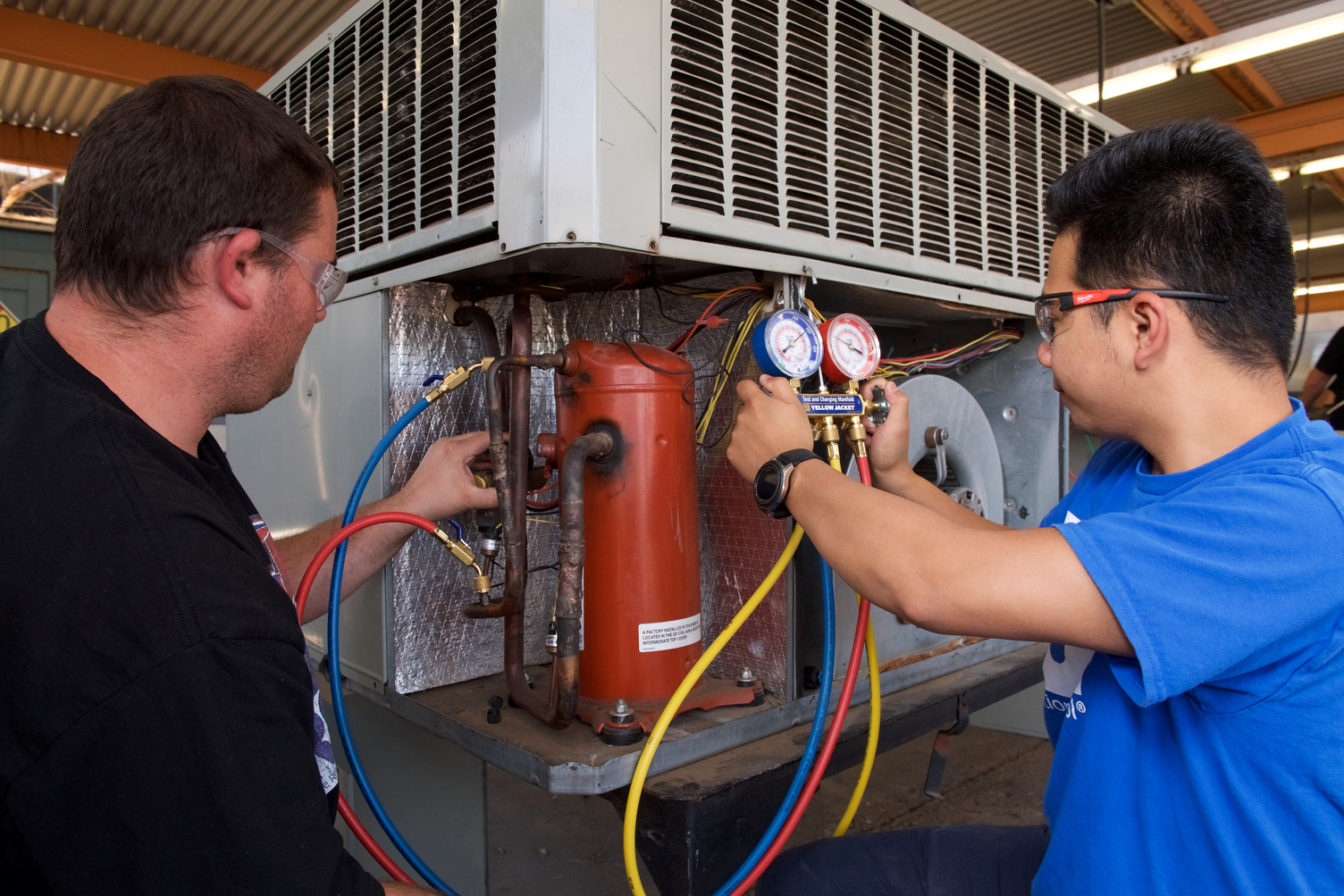
- Lab time on A2L-rated leak detectors, recovery machines, and vacuum pumps
- Section 608 exam prep built around the current flammability content
- ASHRAE 15 charge and ventilation calculations taught as part of the install process
- A2L-specific brazing and charging procedure, alongside the R-410A service work still needed on existing systems
A program missing any of these leaves a graduate to learn A2L handling on the job, on an employer’s time and a homeowner’s system. Every item on that list maps to either the current Section 608 exam content or a real, on-the-job ASHRAE 15 requirement, not extra material added for depth’s sake.
The Existing R-410A Fleet Still Needs Technicians Who Know A2L
The Bureau of Labor Statistics projects roughly 40,600 HVAC/R job openings a year on average over the next decade, most of them a result of current technicians retiring or leaving the trade rather than from new construction alone.
A large part of that day-to-day work is repair and replacement of existing systems. Every R-410A system installed before 2025 eventually becomes exactly that kind of replacement job, swapped out for A2L equipment. That ongoing replacement cycle is where A2L skills matter just as much as they do on a brand-new install.
A technician trained only on legacy refrigerant can diagnose the old system but can’t install its replacement. That splits one job into two skill sets an employer has to hire separately for, which is exactly the gap A2L refrigerant training closes.
For an employer, that’s the difference between training one generalist and sourcing two specialists for the same service call.
Train on the Systems You’ll Work On
New installs already run on A2L equipment, and the R-410A systems still in the field are being replaced with it too. Training on that equipment now, instead of learning it on a customer’s system after graduation, is what separates a job-ready technician from one still catching up.
Explore the HVAC/Refrigeration Technologies program at TWS, or request more information to talk through class schedules and start dates.