TWS is a Great Training Option for Everyone
Learn more about how we can prepare you to advance your career.
A 2025 Association for Smarter Homes & Buildings (ASHB) survey of 611 U.S. and Canadian consumers found smart home adoption reached 59%, up from 49% in 2024. Smart thermostats were the second most common device among those adopters, at 34%, trailing only entertainment systems. At that level of adoption, most technicians will run into a smart HVAC system on a routine service call.
Thermostat wiring, installation, and programming is already a scoring competency on North American Technician Excellence (NATE)’s Electrical and Controls exam. Interview questions are starting to probe further into the connectivity skills that the exam doesn’t cover. A candidate who can speak to that specifically stands out; one who can’t sounds unprepared
What Makes a Smart HVAC System Different
The ENERGY STAR program, run jointly by the EPA and Department of Energy, defines a smart thermostat as a Wi-Fi-enabled device that lets a homeowner control heating and cooling from a phone, tablet, or computer.
A programmable thermostat runs on a schedule someone enters manually and never changes until a person changes it. A smart thermostat learns the household’s routine instead, adjusting on its own using occupancy and temperature data.
That shift changes what the thermostat needs electrically: a programmable thermostat can run on a battery, but a smart thermostat needs steady power to stay connected to Wi-Fi and run its display, which most models draw through a common wire, or C-wire, tied to the HVAC control board.
Get Started on the Path to a New Career
Fill out our form to learn how we can help you change your life.
A home wired years ago for a battery-powered thermostat may not have one, which is exactly the kind of gap a technician has to solve on-site.
A technician trained on traditional systems has three new judgment calls to make before touching a smart thermostat installation:
- Whether the equipment is even compatible: variable-speed, multi-stage, or zoned systems don’t automatically work with every smart thermostat model, and some setups need professional installation regardless of what the homeowner wants
- Whether the existing wiring signals a problem: thicker wires built for line-voltage control are a sign the system isn’t a straightforward swap, something to recognize before starting the job, not after
- Whether the network can support the device: signal strength and router placement determine whether the thermostat stays connected, a consideration that has nothing to do with refrigerant lines or ductwork
None of this shows up on a traditional thermostat’s install sheet. It’s new territory even for a technician who’s spent years on mechanical systems.
What a Smart Thermostat Service Call Involves
Contractors now price a smart thermostat into the base proposal instead of pitching it as a separate upsell, and lean on standardized commissioning checklists to catch a bad configuration before it becomes a callback. That only works if the technician doing the install already understands the equipment.
Communicating thermostats, models built to exchange real-time data with the equipment instead of sending a basic on-off signal, now auto-identify what’s connected and apply settings on their own. That cuts setup time, but only if the technician can confirm those automated settings are actually correct instead of accepting them by default. And a home without a common wire, still common in older construction, needs a technician who can wire around it with an equipment interface module instead of opening a wall to run new wire.
None of this is optional knowledge anymore. It’s the baseline for a normal service call.
What This Can Sound Like in an Interview
HVAC interview questions increasingly ask a version of the same open-ended prompt:
- Indeed: “How do you learn about new technology and standards in HVAC?”
- Jobber (apprentice track): “How do you stay current with new HVAC technologies or industry standards?”
- A separate guide: “How do you stay updated on HVAC technology or codes?”
That question is an opening. The third guide’s answer key tells hiring managers to listen for “familiarity with tools or trends like smart thermostats or mini-splits.” A candidate who brings up smart thermostat experience unprompted is answering exactly what that guide tells the interviewer to listen for.
What NATE’s Certification Tests, and What It Doesn’t
NATE’s Certified HVAC Professional (CHP-5) certification pathway runs five exams total:
- HVAC Fundamentals
- Electrical and Controls
- Comfort and Airflow
- Installation
- Service
Electrical and Controls is the domain most relevant to thermostat work. Its published content centers on electromechanical fundamentals:
- Electrical theory, including circuits, voltage, and Ohm’s Law
- Wiring diagrams and field wiring layouts
- Relays, contactors, and gas valves
- Thermostat installation, wiring, and programming, including electronic thermostats
Connectivity skills, Wi-Fi pairing, app configuration, protocols like Zigbee, Z-Wave, and Matter, live outside that exam. That’s where hands-on training beyond the certification actually matters.
Tulsa Welding School (TWS), formerly The Refrigeration School (RSI), operates as a NATE-approved training provider and testing facility, meaning graduates can test toward NATE certification directly through the school. That certification path doesn’t extend to smart thermostat connectivity, which is where TWS’s own curriculum picks up.
An interviewer’s question about Wi-Fi pairing or app troubleshooting is likely probing for something the certification path doesn’t guarantee a candidate has touched.
What Modern HVAC Training Actually Covers
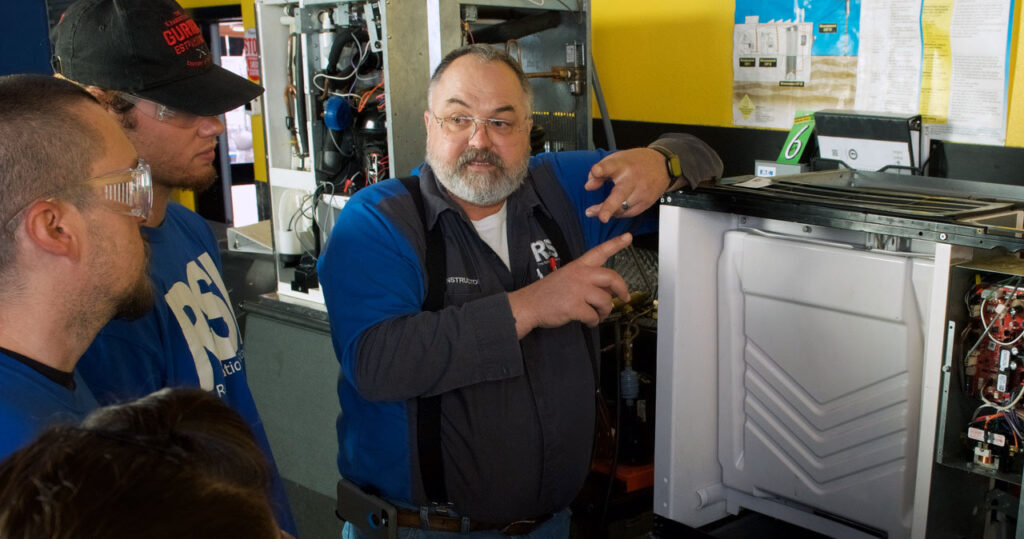
TWS’s HVAC/R program lists installing and programming thermostats, smart controls, and zoning systems as a trained skill. Building automation training covers:
- Sensors that track conditions like temperature, humidity, and occupancy
- Actuators that carry out the system’s response, opening a damper or starting a fan
- The control network connecting them, which a technician traces to confirm each actuator responds correctly to a signal
These are the same fundamentals a connected thermostat runs on. The page states this training can lead to entry-level roles like HVAC controls installer or building systems technician, work that’s common in commercial buildings, hospitals, universities, and data centers.
Thermostats, controls, sensors, and actuators are the components of a smart HVAC system curriculum, the same connectivity content NATE’s certification leaves out. Completing that training is what turns a generic interview answer into a specific one.
What Makes a Candidate Stand Out
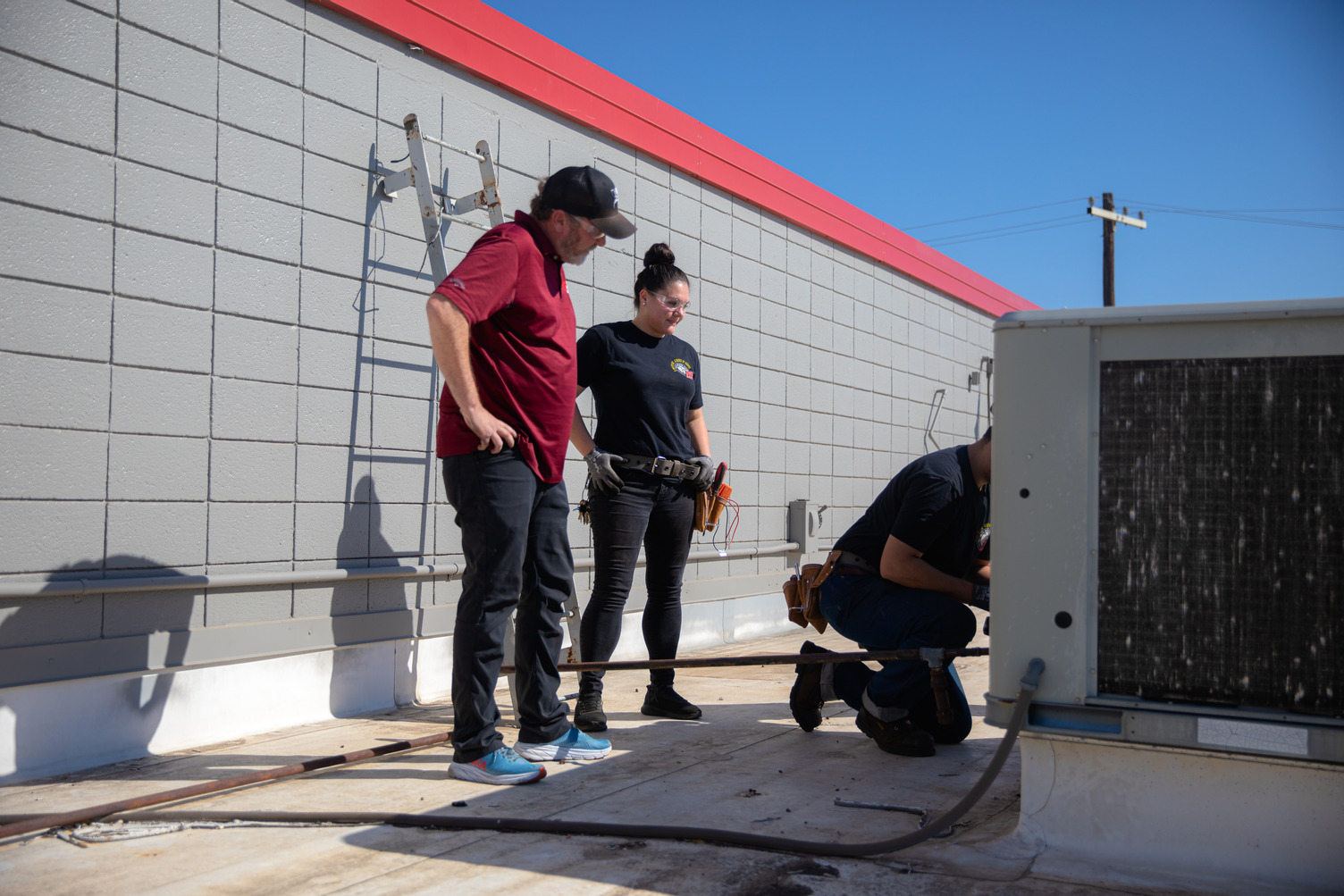
It comes down to arriving at an interview, or a service call, already able to pair a thermostat to Wi-Fi and diagnose a dropped app connection, tasks NATE’s certification path doesn’t guarantee a candidate has done. A candidate who can walk through that process is answering from experience instead of guessing out loud in the interview chair.
In an interview, that means being able to:
- Explain the difference between a programmable thermostat and a smart one without reciting a script
- Walk through troubleshooting a home missing a C-wire
- Explain why an auto-configured setting still needs a second look before signing off on the job
None of that shows up on a NATE transcript. Exam content changes slowly by design, since a national credential has to hold steady across thousands of technicians and testing centers. Equipment doesn’t move at that pace.
Smart home adoption climbed from 49% to 59% in a single year. A national certification can’t update that fast, so the gap between what’s tested and what’s actually installed will likely widen, not close on its own.
A training program built around connectivity from the start is what closes that gap before the first interview.
Learn more information about the HVAC/R Technology program at Tulsa Welding School to see where that training starts.