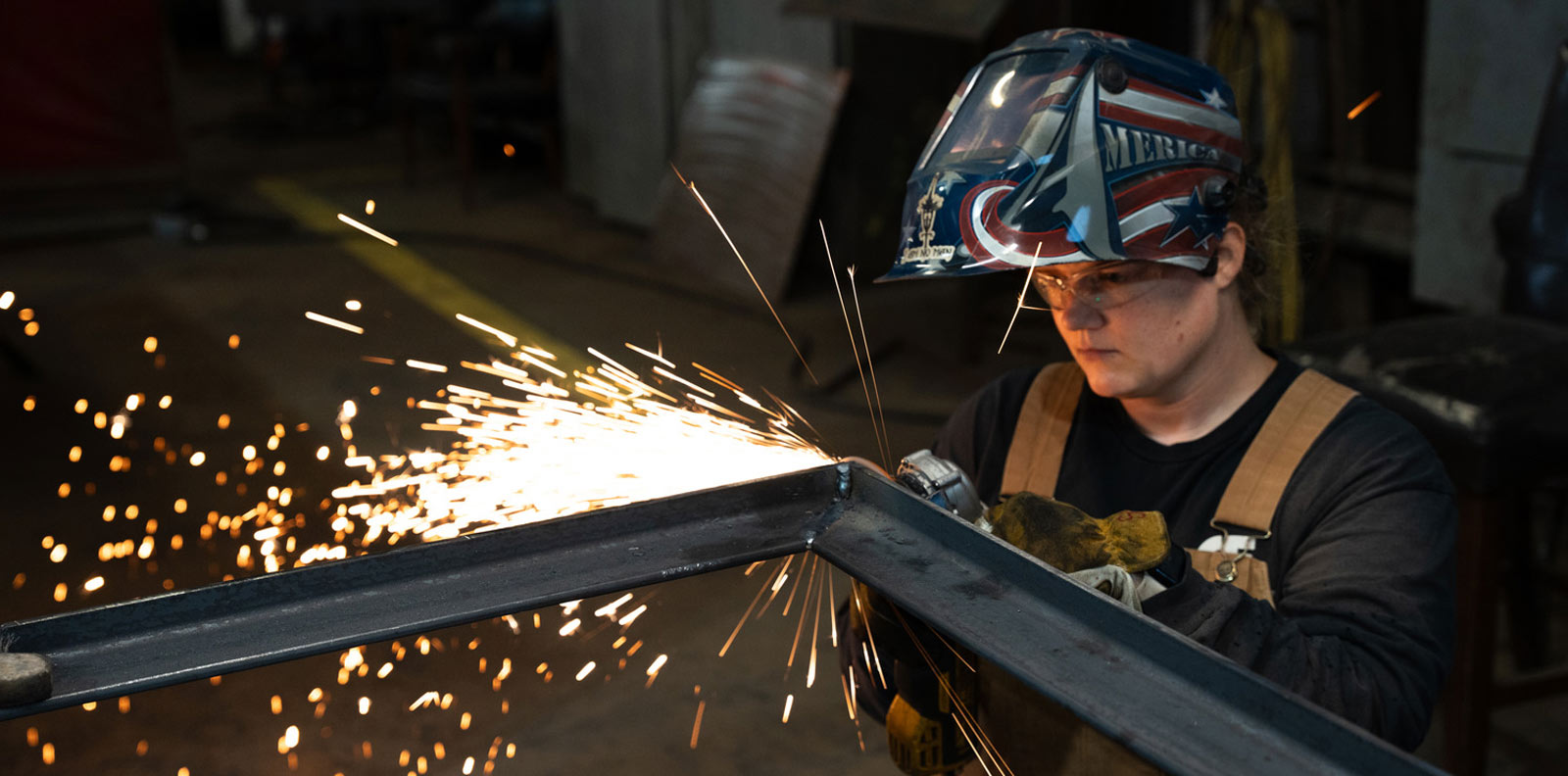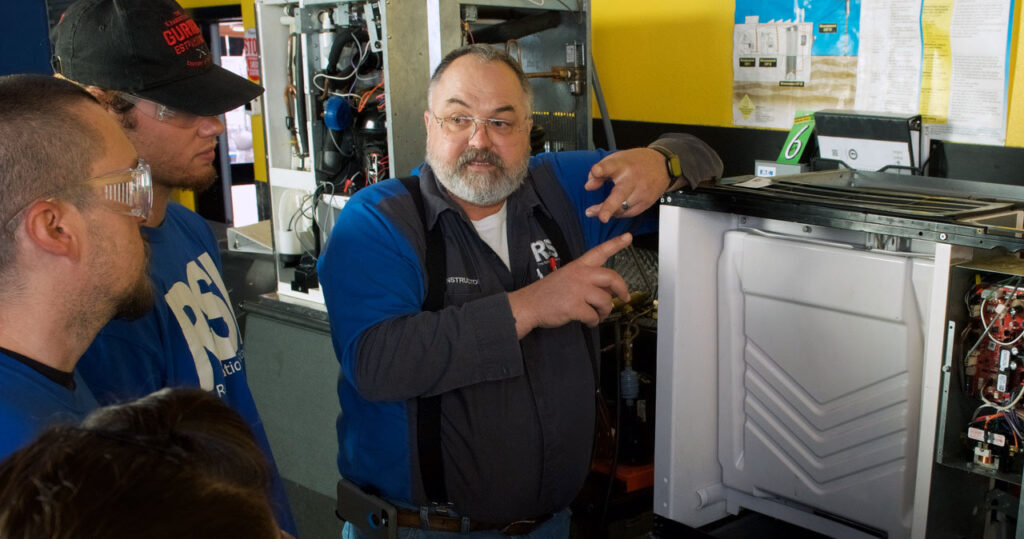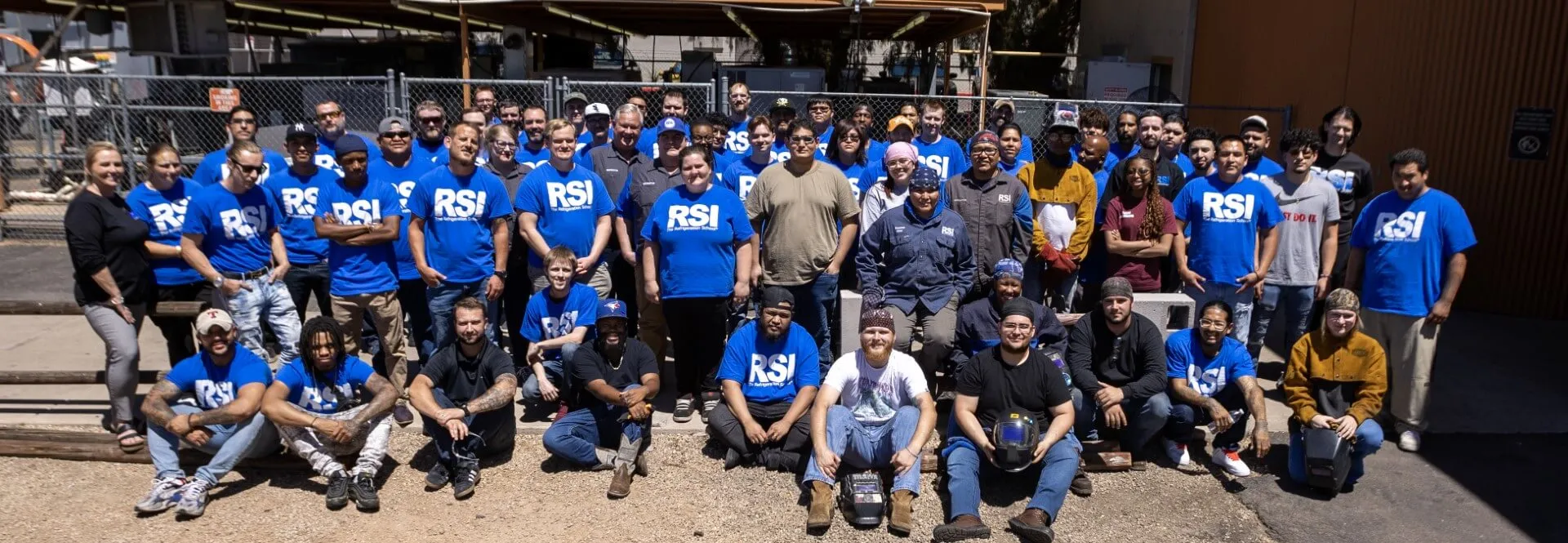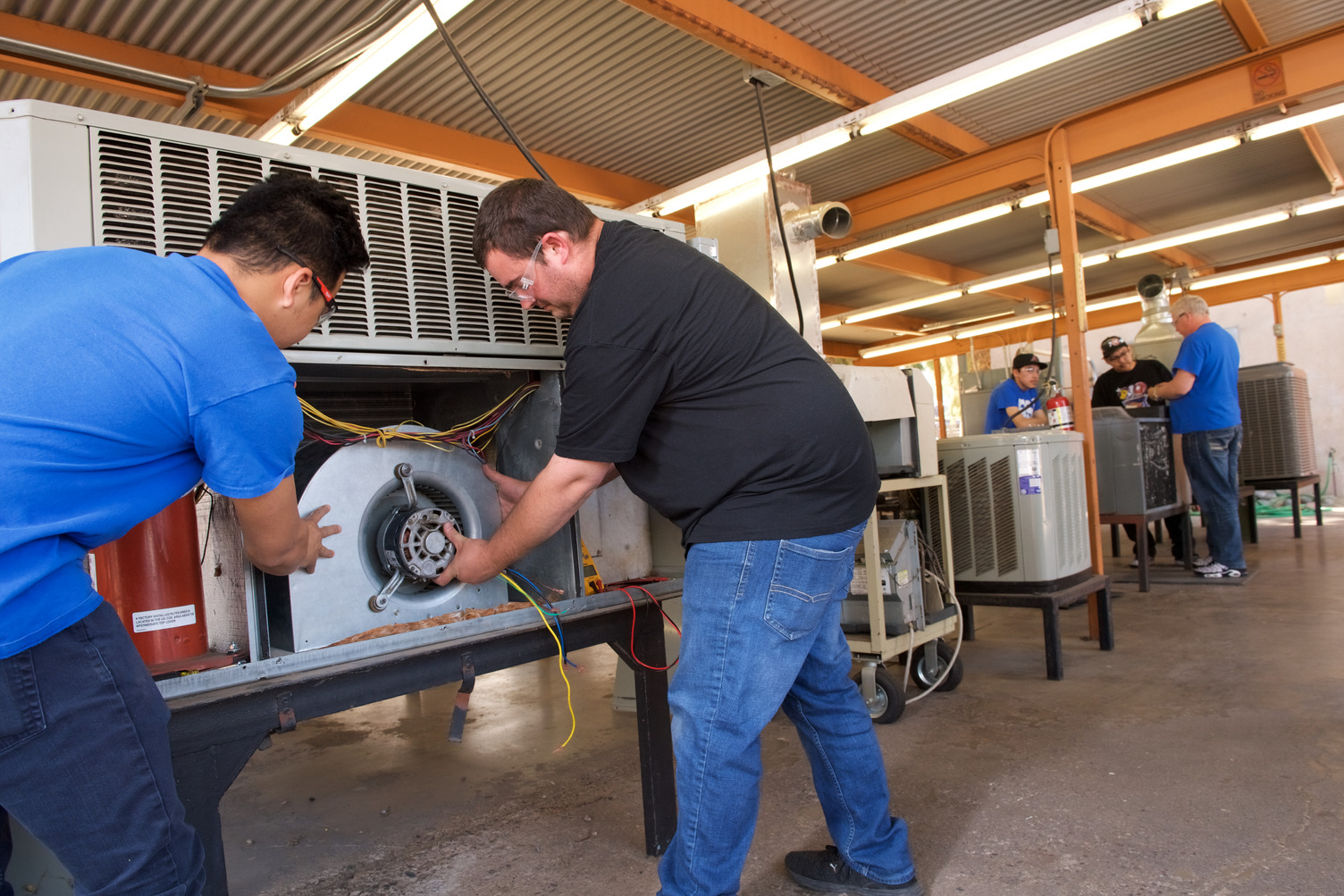
TWS is a Great Training Option for Everyone
Learn more about how we can prepare you to advance your career.
AI was cited as the reason for nearly 40% of all announced job cuts in May 2026. That number has climbed every month since January. At the same time, Phoenix metro construction employment averaged 42,300 workers in 2025, a 6% year-over-year increase, with Phoenix ranking second nationally for active construction projects. Those two trends aren’t unrelated.
Skilled tradespeople in Phoenix enter the workforce months after starting their program, carry far less debt than four-year graduates, and earn above the national median before overtime. The desk job that once looked like the safer, more lucrative path is worth a second look.
What Each Career Path Actually Pays in Phoenix
According to the BLS May 2025 data for the Phoenix metro, annual wages for the major trades look like this:
| Trade | Median | 10th–75th Percentile Range |
|---|---|---|
| HVAC Mechanics and Installers | $61,170 | $38,210–$74,880 |
| Electricians | $61,210 | $46,920–$77,060 |
| Plumbers, Pipefitters, and Steamfitters | $63,750 | $46,530–$90,470 |
Those are median figures, meaning half of all workers in each trade earn more. Overtime is common in the trades. The BLS notes that HVAC technicians frequently work overtime and irregular schedules during peak heating and cooling seasons. For a licensed tradesperson working consistent hours, effective annual compensation often exceeds the posted median.
White-collar entry-level roles tell a different story. Two of the most common destinations for four-year graduates in Phoenix show medians below all three trades listed above, with entry-level pay starting in the low-to-mid $40,000s:
Get Started on the Path to a New Career
Fill out our form to learn how we can help you change your life.
- Human resources specialists: $48,510 to $95,970, with a median of $74,640
- Market research analysts and marketing specialists: $43,120 to $100,600, with a median of $74,590
Those figures also don’t account for student debt payments that typically follow a four-year degree.
What the Degree Actually Costs
A four-year degree carries real debt before a single paycheck arrives. A trade program at The Refrigeration School runs approximately $23,625 for the 2024-2025 academic year. The average total cost of attending a four-year public institution nationally, per the National Center for Education Statistics (NCES), is substantially higher.
That figure doesn’t include room, board, or four years of foregone income.
Job Stability and How AI Is Changing Blue Collar vs White Collar Jobs
The stability argument for white-collar work used to be straightforward. Desk jobs felt predictable, salaried, and protected from the physical risks that came with trade work. That calculus has shifted.
AI-attributed job cuts in 2026 have already surpassed the total for all of 2025. The roles absorbing the most pressure are entry-level and junior white-collar positions. According to research cited in Forbes, the share of companies planning to reduce junior roles jumped from 17% to 43% in a single year. Generative AI is particularly effective at the codifiable, repeatable tasks that make up most entry-level work in marketing, finance, and administration. Those are the exact roles many four-year graduates compete for.
That said, automation is not exclusive to office work. AI is creeping into physical spaces too:
- Robotic manicure machines now operate inside Ulta Beauty locations
- Robotic pickers handle fulfillment in major warehouses
- Automated checkout has replaced cashier roles across retail chains
The difference is that trade work involves licensed skilled judgment, job-site variability, and hands-on problem-solving in conditions AI cannot replicate. A system that won’t start on a 115-degree Phoenix afternoon doesn’t wait for a remote diagnostic.
Phoenix adds two stability factors that don’t apply in most other markets:
- Construction demand keeps climbing. Arizona’s construction workforce grew by nearly 6,000 jobs year over year, and labor shortage remains the most persistent constraint across the industry. The TSMC semiconductor campus in north Phoenix alone is expected to support 40,000 construction jobs over the next four years. Add data centers, industrial facilities, and ongoing residential development, and Phoenix’s trades market is not slowing down.
- Remote work increased white-collar competition locally. As coastal workers relocated to the Valley, competition for local office roles increased significantly. A marketing or business analyst position that once drew local applicants now attracts candidates from across the country. The trades don’t have that problem. You can’t install a commercial HVAC system from another state.
Career Growth in the Trades vs Office Jobs
Both paths offer advancement. The difference is in how predictable and accessible that advancement is.
In the trades, the path forward is tied to documented experience and licensing rather than performance reviews or internal politics. The Arizona Registrar of Contractors (ROC) licenses contractors after four years of documented experience plus passing trade and statutes exams. The progression looks like this:
- Apprentice — Hands-on training under a licensed contractor; wages increase as skills develop
- Journeyman — The City of Phoenix issues journeyman-level HVAC licenses locally, adding a credential milestone before full licensure
- Licensed Contractor — Full ROC licensure after four years of documented experience; authorizes independent work and higher-value contracts
- Business Owner — A licensed tradesperson can launch their own contracting business with a surety bond ranging from $2,500 to $50,000 depending on scope, which is relatively low overhead compared to most entrepreneurial paths
Owning a trade business in a market like Phoenix, where skilled labor is in short supply, is a realistic outcome for someone who puts in the work.
When comparing trade careers vs office jobs on advancement, the white-collar path follows a less defined route. Mid-level roles in marketing, operations, and business often plateau without additional credentials or a willingness to relocate. Senior positions exist, but the candidate pool in Phoenix has grown significantly since 2020.
Specialization helps in both paths, but in the trades, it tends to raise your rate rather than require a new degree. RSI offers programs in HVAC/R, electrical, and welding, each with distinct specialization tracks in commercial, industrial, and electro-mechanical work that can expand earning potential without starting over.
The Physical Demands of Trade Careers and White-Collar Jobs
Neither path is free of physical cost. The nature of that cost just differs.
| Factors | Trade Careers | White-Collar Jobs |
|---|---|---|
| Physical demands | Lifting, crawling, tool operation, outdoor exposure | Sedentary, extended screen time, low physical strain |
| Health risks | One of the highest injury rates of all occupations; long-term wear on knees, back, and shoulders | Burnout, sedentary health consequences, sustained stress |
| Phoenix-specific factor | Summer heat regularly exceeds 110 degrees for outdoor roles | Indoor year-round; heat is not a factor |
| Schedule | Earlier start and end times; some roles include on-call | Predictable structure; often extends into evenings through email |
| Long-term options | Can move into commercial work, controls, or estimating to reduce physical demands | Role structure rarely changes; burnout can accumulate over time |
Tradespeople who move into commercial work, controls, or estimating over time tend to reduce their physical exposure without leaving the field. That flexibility is one of the more meaningful differences in the blue collar vs white collar jobs comparison, and it rarely comes up in salary charts.
Quality of Life on Each Path
Beyond wages and stability, the day-to-day feel of a career matters. For a lot of people considering the blue collar vs white collar jobs question, that’s actually the deciding factor.
Trade work offers something office work rarely does: the end of a shift that feels finished. A system is running or it isn’t. A weld holds or it doesn’t. That tangibility is meaningful to people who find satisfaction in concrete outcomes. Tradespeople also tend to work with more autonomy than their white-collar counterparts, with less direct supervision and more ownership of the job in front of them.
Phoenix’s cost of living is a relevant frame here.
The metro has surpassed 5.2 million residents, and housing demand continues to be driven by population growth and job creation. A licensed HVAC technician or electrician earning at or above the BLS median in Phoenix is positioned to support a household in a city that still offers more affordability than coastal markets, even when compared to a white-collar worker carrying student loan payments into their 30s.
Side work is another advantage that belongs to the trades. A licensed technician with a truck and the right insurance can take on residential service calls outside of their primary job.
That supplemental income option typically doesn’t exist in most white-collar careers in any comparable way.
Time and Money to Get Started
The final comparison is the most practical. What does it actually cost to start, and how long until you’re earning?
| RSI Trade Program | 4-Year Public University | |
|---|---|---|
| Program length | As few as 7 months | 4 years |
| Tuition (2024–2025) | ~$23,625 | Significantly higher per year, before room, board, and books |
| Financial aid | Available for qualified programs | Available, but often insufficient to offset full cost |
| Entry requirements | No GPA or standardized test scores; based on readiness and commitment | GPA, standardized tests, application process |
| Time to first paycheck | Months | Years |
| Hidden costs | Minimal | Internships, unpaid experience, and graduate credentials increasingly required for competitive roles |
By the time a four-year graduate starts working, an RSI graduate may already have three-plus years of experience, licensing progress, and compounding wages behind them. White-collar entry has also gotten more expensive in a less obvious way. The degree costs more and guarantees less than it did a generation ago.
If you’re in Phoenix and weighing your options, the trade school vs college salary gap matters. So does when you start earning, how much debt you carry into your career, and whether the work itself is something you can sustain for decades.
Ready to See What RSI Offers?
If the comparison points toward trades, the next step is finding the program that fits your goals.
RSI offers training in HVAC/R, electrical, and welding at its Phoenix campus, with programs designed to get you working in months, not years. Explore RSI programs and see which path fits where you want to go.