TWS is a Great Training Option for Everyone
Learn more about how we can prepare you to advance your career.
In March 2024, Intel confirmed $8.5 billion in CHIPS Act funding, bringing its total investment at its Chandler campus to $34.5 billion. Amkor Technology had already committed $2 billion that February to a new packaging facility in Peoria. By October 2025, it expanded the project to $7 billion across two phases.
In July 2026, Taiwan Semiconductor Manufacturing Company (TSMC) raised its total Arizona commitment to $265 billion. That’s enough to fund 10 fabs, two advanced packaging facilities, and a research center in north Phoenix alone.
Every one of these projects depends on structural steel going up on schedule. Unfortunately, the number of certified structural welders coming out of Phoenix classrooms is falling behind the number of openings tied to these builds.
What Type of Welding Is Most in Demand in Phoenix Right Now
Structural welding is the common thread across all three projects above. It falls under the D1.1 code, the standard covering steel buildings, bridges, and heavy fabrication anywhere in the Valley’s data center and semiconductor corridor. Three welding processes account for most of the work on these job sites:
- SMAW (stick welding), still common on structural steel and field repair, and often the first process a new welder tests in
- GMAW and FCAW (MIG and flux-core), used heavily in fabrication shops and on-site erection because of the speed they add to a crew
- GTAW (TIG), used where precision and clean welds matter most, including thinner materials and exposed joints
Pipe and thin-alloy welding round out the picture, useful for graduates who want to work across HVAC, mechanical, and industrial projects instead of staying locked into one lane. A new welder who can certify in more than one of these processes has a wider set of job sites to choose from.
Get Started on the Path to a New Career
Fill out our form to learn how we can help you change your life.
Why the Valley’s Build-Out Is Outpacing the Welder Supply
TSMC’s Arizona build-out alone is projected to support 40,000 construction jobs. That figure was calculated before the company’s July 2026 expansion pushed its total investment to $265 billion. Nationally, the picture behind that demand is just as tight. The welding workforce is aging.
The U.S. needs roughly 320,000 new welders by 2029, as veteran welders retire faster than new ones are trained. AWS’s own ironworker career data covers one of the structural welding roles most in demand on projects like these. Entry-level pay runs between $40,000 and $55,000 a year. Experienced ironworkers earn $60,000 to $75,000, and certified ironworker welders or foremen clear $80,000 or more.
Phoenix is competing for the same shrinking pool of certified welders as every other CHIPS Act state chasing semiconductor and data center construction. This national competition raises the stakes on local training pipelines, which need to produce structural welders fast enough to keep up with what’s already under construction in the Valley.
The timing lines up closely with the construction schedule for TSMC’s remaining fabs, expected to reach production between 2027 and the end of the decade.
What Welding Certifications Do Companies in Phoenix Actually Want When Hiring
Employers hiring for structural work look for proof of skill in three specific forms:
| Credential | What It Proves |
|---|---|
| AWS Certified Welder | Performance-based test in a specific process, position, and material thickness |
| D1.1 qualification | The welder can meet the structural steel code employers reference most often on job sites |
| Employer WPS testing | A weld tested against a specific Welding Procedure Specification, usually under a Certified Welding Inspector |
Certifications are specific, not general. A welder qualified in 3G SMAW isn’t automatically qualified in overhead GTAW. That’s why employers ask about process and position, not just whether a candidate holds “a certification.” The AWS Certified Welder test itself requires no prior coursework. It only asks for a passing performance on the actual weld.
That’s why trade school programs built around AWS-aligned exams can help move a student from classroom to credential and into the workforce in a relatively short timeframe.
Is Trade School or an Apprenticeship Faster for Getting a Welding Job in Arizona
Trade school and apprenticeship training differ in three ways: how long each takes, how the training is structured, and which path each is best suited for.
| Factors | Trade School | Apprenticeship |
|---|---|---|
| Timeline | About 7 months | 3 to 4 years |
| Structure | Full-time classroom and lab training | Paid on-the-job training, often union-based |
| Best for | Entering an active hiring market quickly | A specific industrial or pipeline career track |
Trade School Timeline and What You Learn
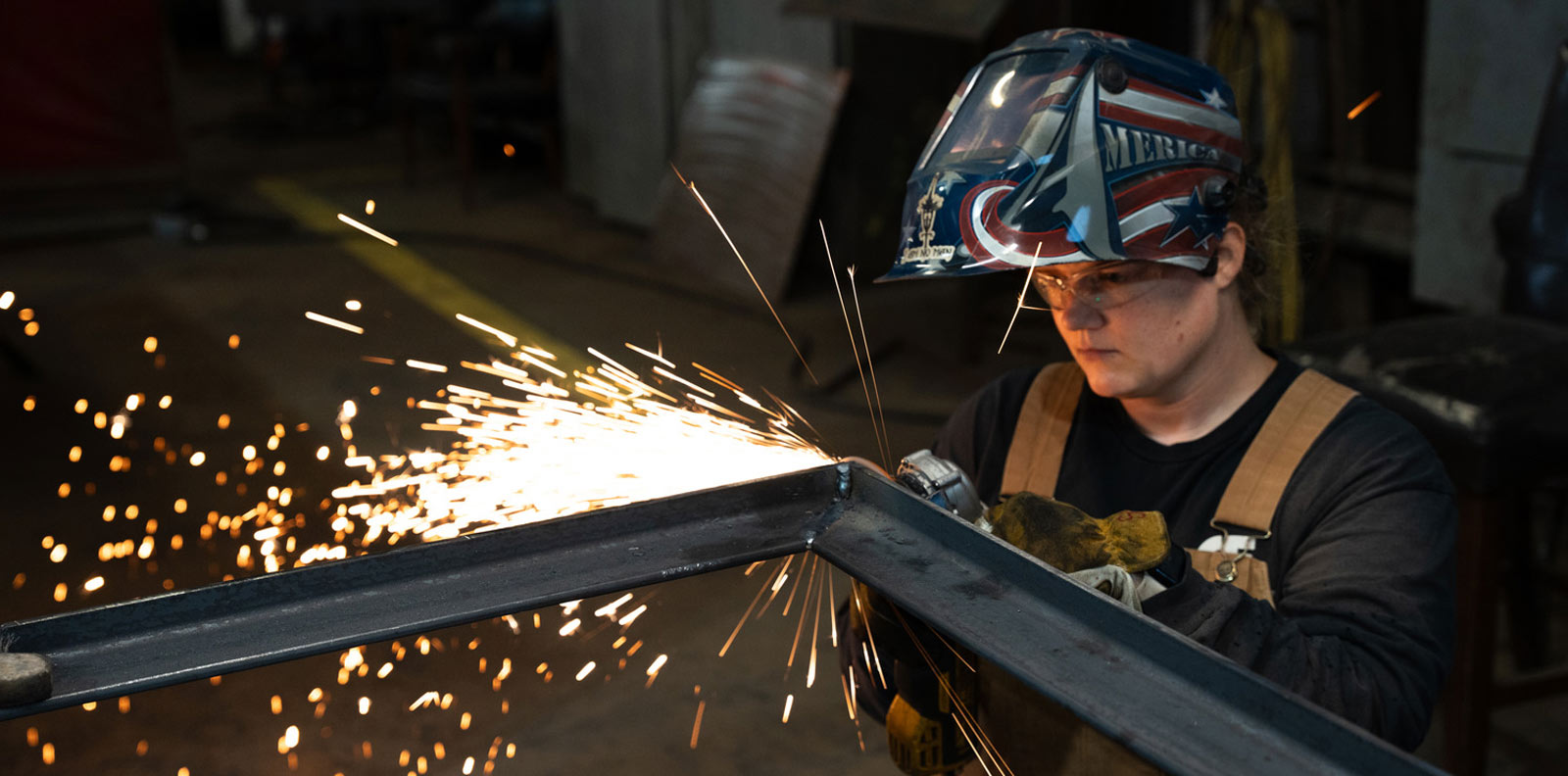
A welding trade school program built around structural, pipe, and thin-alloy welding runs about seven months, most of it hands-on lab time rather than lecture. Students spend their days running SMAW, GMAW/FCAW, and GTAW processes on real equipment. Along the way, they learn blueprint reading and welding symbols, then test toward AWS-aligned qualifications before they graduate.
Apprenticeship Timeline and What You Learn
A welding apprenticeship typically runs three to four years of paid, on-the-job training. It’s often run through a union or industrial employer like the Ironworkers or Boilermakers. Apprentices work a full-time schedule under a mentor. They log classroom hours alongside thousands of hours of supervised fieldwork before they’re fully qualified. Pay starts lower than a trade school graduate’s first job, but it comes with steady, structured advancement.
It’s a strong route into a specific pipeline or heavy industrial track. But it’s a slower entry point into a market like Phoenix’s, where demand is immediate.
A seven-month trade school program paired with an AWS certification produces entry-level qualification faster than the three-to-four-year apprenticeship track. That speed matters when hiring demand is already this active.
Where New Welding Graduates Are Landing Jobs in the Valley
Certified structural welders aren’t limited to one type of employer right now. The current build-out is spreading demand across several entry points:
- Structural steel fabrication shops supplying the data center and semiconductor build-out
- On-site erection crews working on commercial and industrial job sites
- HVAC and mechanical contractors, where pipe and thin-alloy skills carry over directly
- Specialty fabricators serving the supply chain around TSMC, Intel, and Amkor
A graduate who can certify in more than one process, structural, pipe, or thin-alloy, has more of these doors open at once. Multiple sectors across the Valley are hiring for that same skill set at the same time. A graduate stepping into this market now has more open positions to choose from than one would have found two years ago.
Ready to Get Started?
Phoenix‘s construction pipeline isn’t slowing down, and neither is the need for welders who can prove they belong on a structural steel job site right now. TWS’s Welding Specialist program trains students in structural, pipe, and thin-alloy welding in as little as seven months.
None of the demand covered here is slowing down anytime soon. Neither is the shortage behind it. The Tulsa Welding School Phoenix Welding Specialist program is built to close that gap, with day, evening, and flexible scheduling for people already working full-time.
Reach out today to talk with an admissions advisor and find out how soon you can start training.