RSI is a Great Training Option for Everyone
Learn more about how we can prepare you to advance your career.
Not every electrician works on the same systems. Some spend their days moving between homes, troubleshooting flickering lights and upgrading panels for homeowners. Others work on job sites where a single electrical room feeds thousands of square feet of retail space, or where a wiring error can take down an entire floor of a building.
Both paths draw on the same core skills, but the voltage levels, materials, and job-site environment look different the moment you step on site. Knowing those differences early is part of knowing what the trade actually demands and what a solid training foundation prepares you to handle.
What’s the Real Difference Between Commercial and Residential Electrical Systems?
Residential systems and commercial systems serve fundamentally different purposes, from powering a single-family home to running the electrical infrastructure of an office building, retail center, warehouse, or hospital. That gap in scale affects nearly every technical decision an electrician makes, from the wire they pull to the panel they wire into.
Voltage Levels, Panel Sizes, and Load Demands
Standard home electrical service in the United States runs on 120/240-volt single-phase power. The 120-volt circuits handle lighting and standard appliances, while larger appliances like dryers and HVAC systems draw from the 240-volt side. Most residential panels are rated between 100 and 200 amps.
Commercial buildings require a different class of power. Because single-phase systems briefly drop to zero between cycles, they cannot reliably sustain the heavy, continuous loads found in commercial spaces.
Get Started on the Path to a New Career
Fill out our form to learn how we can help you change your life.
Three-phase power solves this by running three overlapping electrical cycles simultaneously, so the supply never drops, making it the standard for buildings that run large HVAC systems, motors, and lighting arrays.
Depending on the facility, you might encounter 208-volt, 277-volt, or 480-volt three-phase systems. Commercial switchgear and panels can handle thousands of amps, and an error at that voltage carries consequences far beyond a tripped breaker.
Wiring Methods and Materials
In residential work, the standard wiring method is non-metallic sheathed cable, often called Romex by its brand name. It is flexible, easy to run through wall cavities, and appropriate for most home wiring projects under the NEC®.
Commercial installations call for a different set of tools and materials. Rather than flexible cable, wires run through protective conduit or metal-clad assemblies built to handle higher physical demands.
Common commercial wiring methods include:
- Electrical metallic tubing (EMT): A lightweight steel conduit widely used in commercial interiors for its durability, clean appearance, and ease of future rewiring
- Rigid conduit: Heavier-duty metal conduit used where maximum physical protection is required, such as exposed runs or harsh environments
- Polyvinyl chloride (PVC) conduit: A corrosion-resistant plastic option common in underground or wet installations
- Metal-clad (MC) cable: A flexible armored cable used where conduit runs are impractical, such as tight spaces or complex bends
Conductors are also often larger gauge to handle heavier loads, and circuit layouts are significantly more complex, with dedicated circuits for specialized equipment, emergency systems, and fire alarm integration.
| Feature | Residential | Commercial |
|---|---|---|
| Voltage | 120/240V single-phase | 208V, 277V, or 480V three-phase |
| Panel capacity | 100–200 amps | 400–4,000+ amps |
| Primary wiring method | NM cable (Romex) | EMT, rigid conduit, MC cable |
| Typical circuit complexity | 15–30 circuits | 100+ circuits with dedicated loads |
| Code layers | NEC® plus local amendments | NEC® plus fire alarm codes, ADA, and commercial amendments |
Both paths require fluency in the National Electrical Code (NEC), the benchmark standard for electrical design, inspection, and installation adopted in most U.S. jurisdictions. Commercial work layers additional requirements on top of that foundation: fire alarm standards, accessibility requirements, and jurisdiction-specific amendments that vary by building type and occupancy class.
Is Residential or Commercial Electrical Work Better to Start With if I Am Brand New to the Trade?
There is no universal right answer, and most working electricians will tell you the same thing. The core skills are the same regardless of where you end up:
- Circuit theory
- Load calculations
- Safety protocols
- Tool proficiency
- Blueprint reading
- EC® application
What shapes which direction you go is usually a combination of the jobs available in your local market and what kind of work fits how you operate.
How Electrical Training Builds Skills for Both Paths
Structured electrical training covers the fundamentals that apply regardless of where you eventually work.
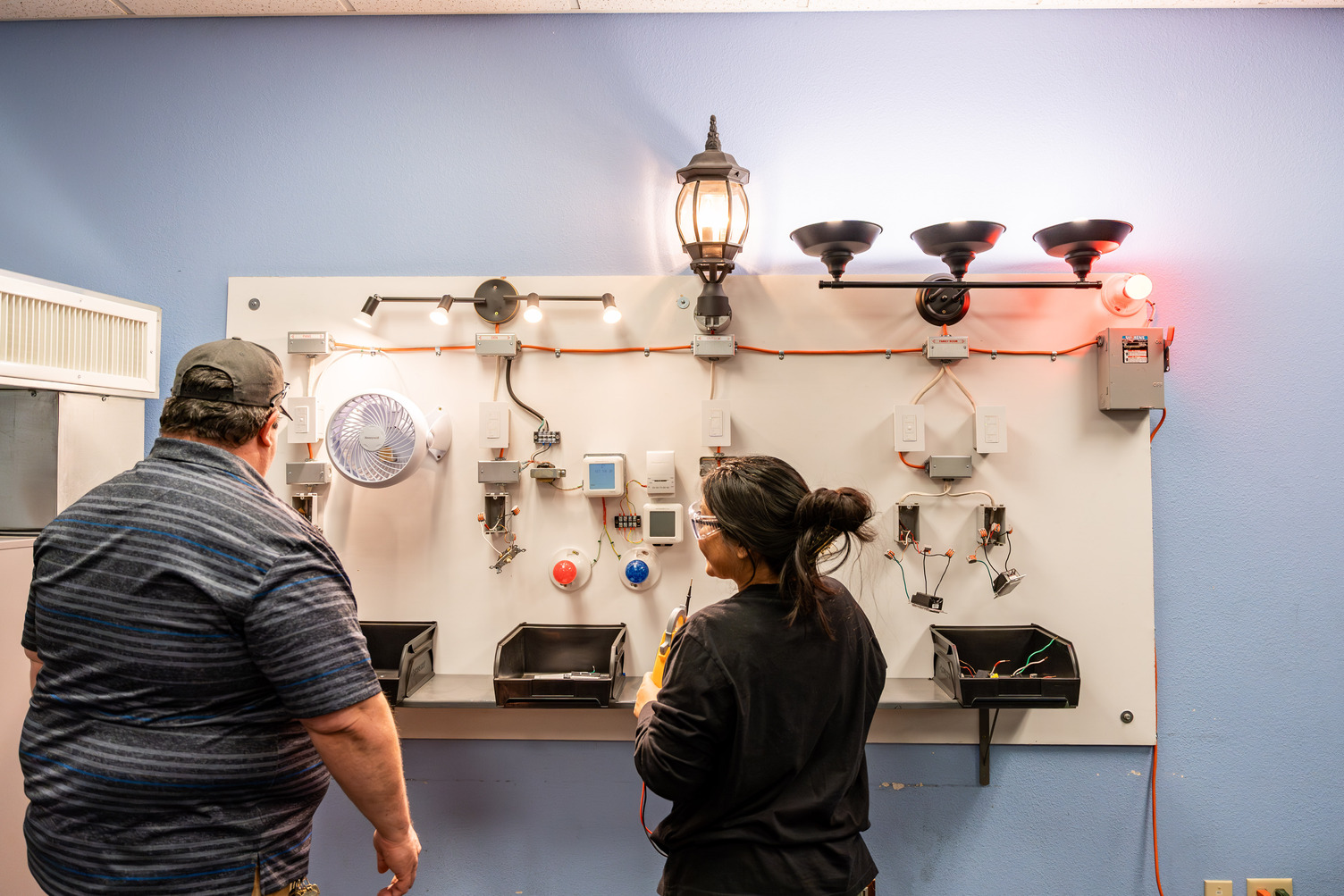
At The Refrigeration School, Inc. (RSI), the Electrical Technologies program covers electrical principles, residential and commercial wiring, smart home technology, motors and lighting practices, and electrical distribution systems, all complete in as little as seven months. Students wire a scaled-down residential home, study commercial wiring techniques through the NEC®, and get hands-on troubleshooting experience with real equipment.
Graduates leave with working knowledge of both residential and commercial systems, which makes them more competitive candidates for entry-level positions and apprenticeships. From there, some electricians settle into residential work because they prefer the variety of moving between different homes and working directly with homeowners.
Others gravitate toward commercial projects because they want to work as part of a larger crew on a long-term build. The factors worth considering before you start are your work-style preferences and your local job market. Training gives you the foundation to pursue either one.
What Does Troubleshooting Look Like for an Electrician on a Real Job?
Troubleshooting is what separates an electrician who can install from one who can fix. It is also the hardest part to picture before you have done it.
Troubleshooting in a Residential Setting
A homeowner calls because half the outlets in their kitchen stopped working. The first step is gathering information: what happened right before the outlets went dead, has a breaker tripped, are other rooms affected?
From there, the diagnostic process is systematic. You check the breaker panel, test the outlets with a multimeter to confirm whether voltage is present, and trace the circuit from the panel to the affected outlets. That break might be a loose connection in a junction box, a faulty Ground Fault Circuit Interrupter (GFCI) outlet cutting power to downstream receptacles, or an overloaded circuit that keeps tripping under load.
Common residential faults include:
- Overloaded circuits in kitchens and bathrooms where high-draw appliances share wiring
- Tripped or failed GFCI outlets interrupting power to downstream receptacles
- Outdated wiring in older homes that no longer meets current NEC® requirements
- Loose connections produce intermittent faults and flickering lights
The fix might take fifteen minutes or two hours. The method is the same either way: isolate, test, diagnose, repair.
Troubleshooting in a Commercial Setting
A retail store has lost power to an entire section of overhead lighting. The scale is bigger, but the method holds. You start at the electrical panel or switchgear, which in a commercial building may be in a locked mechanical room with dozens of breakers and multiple sub-panels.
You check the relevant breaker and verify power with a meter. If the breaker is intact, you trace the circuit forward: a junction box, a relay, or a lighting contactor controlling that zone. You reference the building’s electrical schematics, coordinate with the facility manager to confirm circuit assignments, and use diagnostic tools suited to three-phase systems.
Commercial troubleshooting introduces additional variables: motor controls, fire alarm integration, emergency lighting systems, and energy management controls that interact with how circuits behave. At its core, the process is identical to what you practiced in training. Isolate the fault, test the components, diagnose the root cause, make the repair. The setting changes. The method does not.
What Jobs Can You Get as a New Electrician in Tulsa and What Do They Pay?
Oklahoma’s electrical market runs on construction, infrastructure, and energy. Tulsa, as the state’s second-largest metro area, offers residential, commercial, and industrial opportunities for someone entering the trade without prior experience.
Entry-Level Electrical Roles in the Tulsa Area
Common entry-level roles for graduates of electrical training programs include:
- Electrician’s helper or apprentice electrician: Working under a licensed journeyman on residential or commercial job sites, logging supervised hours toward licensure
- Maintenance electrician: Performing scheduled maintenance and repairs on electrical systems in commercial buildings, apartment complexes, or industrial facilities
- Residential rough-in and finish electrician: Wiring new-construction homes from framing through final fixture installation
- Low-voltage or structured cabling technician: Installing data, communications, and security wiring in commercial and residential settings
Pay Expectations for New Electricians in Tulsa
Salaries vary by role, experience, and sector. The average annual salary for electricians in Oklahoma, as of May 2024, was $62,850, but most salaries fell between $37,080 and $75,200 according to data from the Bureau of Labor Statistics.
BLS also projects 9% job growth for electricians from 2024 to 2034, roughly three times the average for all occupations, with about 81,000 openings projected annually.
Commercial and industrial electricians tend to earn more over time, given the complexity and risk involved. Residential work offers more consistent volume. Housing demand does not stop.
Where to Go From Here
If you are weighing whether this is the right path, there has never been a better time to find out. Demand for trained electricians is outpacing supply across the country, and employers are actively seeking people who bring real, foundational skills.
You do not need to have your specialty figured out before you begin. What matters is building the skills that make you hireable in either direction, and the sooner you start, the sooner you can start applying for your next gig.
RSI’s Electrical Technologies program covers residential wiring, commercial wiring, NEC code study, smart home technology, motors, lighting, and electrical distribution, with hands-on lab time taught by working industry professionals, all of which can be completed in as little as seven months.
Request more information from RSI or schedule a campus visit to see the program and facilities for yourself. The career starts with a conversation.